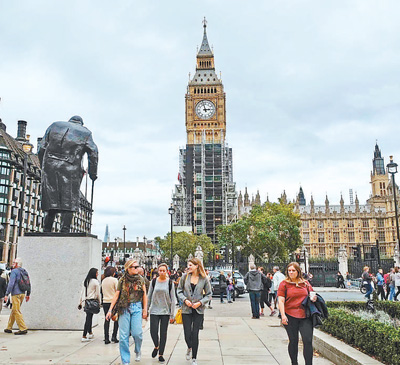
The deadlock in the "Brexit" negotiations has cast a shadow of uncertainty on the British economy. The picture shows pedestrians passing Big Ben, a landmark building in London.
Core reading
On October 12, the fifth round of "Brexit" negotiations between Britain and the European Union came to an end in Brussels, and the negotiations ended without results and reached a deadlock. Seven months after the start of the "Brexit" negotiation process, Britain and Europe still have not reached a consensus on the key issues in the first stage, such as the protection of citizens’ rights and interests, the list of expenses, and the border arrangement. The stagnation of the negotiation process has cast a shadow over the British economy, and at the same time, the negotiation ability and leadership of British Prime Minister David Theresa May have been questioned, which in turn has brought greater uncertainty to the prospect of "Brexit" negotiations.
The two sides are caught in the first stage of negotiations, "no agreement ‘ Brexit ’ " Speculation worries all parties.
Michelle Banier, the chief representative of the European Commission’s "Brexit" negotiations, said at a press conference on the 12th that the negotiations were in a "worrying deadlock". He said, "The fifth round of negotiations this week clarified some key points in a constructive spirit, but it did not take a big step forward." Banier once again stressed that the EU will not make concessions in the negotiations on civil rights, Irish borders and expenses.
David, the chief representative of Britain, said that this week, the two sides of the negotiations have enhanced the common goal consensus, but "there is still a lot of work to be done." Davis once again put pressure on the EU to start the second phase of trade negotiations, saying that "in order to provide certainty, we must talk about the future". However, the EU insists that the current negotiation results are not enough to start the second stage of trade negotiations.
According to the original plan of the negotiations, the EU summit on October 19-20 will exchange views on whether to enter the second stage of the "Brexit" negotiations. However, it seems very difficult to start the second stage at present. Juncker, president of the European Commission, also said that it is very difficult for the negotiations to enter the second stage. At present, the two sides are still in the "wrangling" of the first stage of negotiations.
Speaking in Parliament on October 9th, British Prime Minister Theresa May said, "We expect the negotiations to enter the next stage, but the ball is in the EU’s side", implying that we expect the EU to make concessions and take the first step to break the deadlock. This speech triggered a rebound in the European Union, and Margaritis Skinas, the chief spokesman of the European Commission, said, "There is obviously a sequence of negotiation topics, the first stage — — That is ‘ Brexit ’ The procedural problems have not yet achieved results, so the ball is entirely on the British side. Britain must take action to promote the rest of the steps. "
Theresa May said that Britain needs to be prepared for the final failure of the Brexit negotiations, and revealed that the British government has already started relevant preparatory work. This remark sparked heated public opinion, speculating whether the British government has begun to move toward "no agreement ‘ Brexit ’ " Move in the direction. In response, European Council President Tusk responded that the EU will not be "no agreement ‘ Brexit ’ " Get ready. Tusk once warned, "No agreement ‘ Brexit ’ " The result will be a lose-lose, and Britain will bear the brunt.
Once there is no agreement, the existing convenience arrangements between Britain and the European Union in terms of trade, personnel and tariffs will expire in March 2019, which will undoubtedly have a huge impact on Britain’s trade, personnel flow, services, especially the financial industry. Philip hammond, the British Chancellor of the Exchequer, said, "No agreement ‘ Brexit ’ " The plan is not supported. He said that Britain should only consider "no agreement" at the last minute. In his speech on the 11th, Hammond admitted that the current negotiation process has cast a shadow of uncertainty on the British economy.
The British Conservative government was accused of poor negotiations, and the Prime Minister faced leadership challenges from within the party.
“脱欧”谈判陷入僵局,英国民众对政府处理“脱欧”谈判的信任度已降到历史最低点。根据最新民调,自今年夏天以来,认可政府谈判表现的比例已经从6月的54%下降到本月初的36%。10月4日,在保守党年会上,首相特雷莎·梅在演讲中连续遭遇“抗议者递上‘辞职信’”等意外“插曲”,甚至有约30名下议院议员酝酿发起对特雷莎·梅的不信任议案。
眼下,英国保守党政府被指责谈判不力,其削减公共开支的财政紧缩政策屡遭质疑,政府权威也受到挑战。特雷莎·梅在保守党内的领导权面临挑战,这给未来的“脱欧”谈判前景带来更大的不确定性。
特雷莎·梅今年6月提前举行大选未能如愿稳固其执政地位,保守党反而失去议会多数党地位,加之在伦敦大火后应对不佳,领导力不断遭受质疑。近几个月来,保守党政府内部,不时有内阁成员在“脱欧”问题上表达不同意见。特别是外交大臣鲍里斯·约翰逊曾两度阐述其“荣誉脱欧”计划,与政府立场有出入,约翰逊与特雷莎·梅的政治对立意味越来越明显。不过,面对来自党内反对者发起的挑战,特雷莎·梅强调,目前英国需要“沉稳的领导力”,她不会辞职,并且能够得到内阁的足够支持。
According to the data released by the Organization for Economic Cooperation and Development on October 9, the global economy is expected to maintain a strong growth rate in 2018, but Britain may not be among them. Indicators show that Britain’s economic performance in the first half of this year has slipped to the last among the seven major industrial countries. Experts believe that the devaluation of the pound caused by Brexit, the rising inflation rate and the uncertainty of the relationship between Britain and its major trading partners are the reasons for this phenomenon.
A survey report by the British Agriculture and Horticultural Development Agency also believes that the most unfavorable situation of "Brexit" may lead to a decline in farm profits in the UK by half. The report pointed out that the subsidies granted by the European Union under the Common Agricultural Policy are very important to the British agriculture and horticulture industry. At the same time, zero-tariff trade with the EU is also related to the survival of British farms. If these two points are affected by "Brexit", British farms will face a serious blow.
(London, October 12 th)