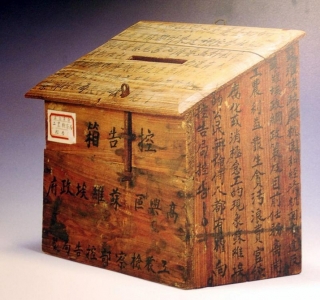
The complaint box for fighting corruption and promoting honesty is now in the National Museum of China.
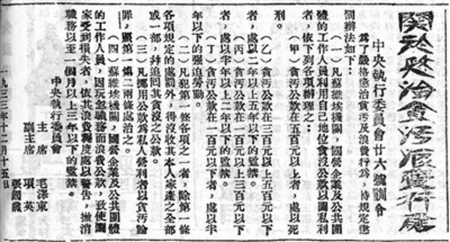
The picture shows the 26th Instruction of the Central Executive Committee — — On punishing corruption and waste. Information picture According to the People’s Court Daily
□ Huaxi Dushi Bao-cover journalist Huang Yong
"As a result of the trial in this court, it is considered that the judgment of the Soviet Judgment Department of Ruijin County against Xie Busheng on May 5, 1932 is correct. Xie Busheng’s appeal was rejected, and he was still executed according to the original judgment of the Soviet Judgment Department of Ruijin County. Xie Busheng was executed at three o’clock and all his personal property was confiscated." On May 9, 1932, the Provisional Supreme Court of chinese soviet republic held a hearing on Xie Busheng’s corruption case, and Liang Baitai, the presiding judge and member of the Judicial People’s Committee of the Central Government, read out the verdict.
At 3 pm, Xie Busheng was executed. The ringing gunshots echoed in the fields and hills in the west of Ruijin City, shaking the whole Soviet area. This was the first shot of the party’s anti-corruption after the establishment of chinese soviet republic. Xie Busheng, chairman of Soviet government in Yeping Village, Ruijin County, became the first corrupt official to be executed since the establishment of chinese soviet republic Provisional Central Government.
Xie Busheng’s corruption case was a typical case of the red storm of "fighting corruption, eliminating corruption and promoting honesty" in the Soviet area at that time. Chinese soviet republic has just been established. Why does the interim central government keep a high degree of vigilance against corruption and waste? Why did Xie Busheng become the first corrupt official to be shot? What kind of tortuous struggle has it experienced?
Set up a complaint box
Central Soviet Area launches anti-corruption struggle.
In February 1932, the soldiers and civilians in the Central Soviet Area were surprised to find that a special wooden box with the words "accusation box" appeared in the conspicuous places of governments at all levels, units, villages, streets and intersections in the Soviet Area.
The National Museum of China now keeps a complaint box, which is made of wood and has a size of 16×18×18.5 cm. On the front, the book neatly reads "Complaint Box", and the accusation system of the workers and peasants procuratorate of the Soviet government in Happy District. The top, left and right sides are all filled with the relevant provisions of the accusation with a brush, and the handwriting is clearly visible. This wooden box, which is almost the same as the household newspaper box, is the first accusation box used in the Communist Party of China (CPC) to fight corruption and promote honesty.
Why did chinese soviet republic, which has just been established for three months, think of using the complaint box to fight corruption and promote honesty?
From November 7 to 20, 1931, the first National Congress of the Chinese Soviet was held in Yeping Village, Ruijin County, Jiangxi Province, announcing the establishment of the provisional central government of chinese soviet republic and Mao Zedong was elected as its chairman.
However, the newly-born Soviet regime is still under the intrusion of old ideas, old customs and old habits. Influenced by various non-proletarian ideas, some cadres and staff in party member do not pay attention to their own integrity, and the system is not perfect, which makes some corrupt elements think that they can take advantage of it, leading to serious corruption and extravagance.
The provisional central government is soberly aware that if corruption cannot be stopped decisively and effectively, put in order’s troops will lose their hearts and minds and combat effectiveness because of self-corruption, which will eventually bring serious consequences to the revolutionary cause of the Party, the Soviet government and the Red Army.
Mao Zedong particularly emphasized: "The banner of communist party is to overthrow all corrupt officials!" "All government workers should be made to understand that corruption and waste are great crimes." "When the corrupt officials of the Kuomintang are all over the country and the people dare to be angry but dare not speak, this phenomenon is absolutely not allowed under the Soviet system. If Soviet staff find corrupt, slacking and bureaucratic elements, the people can immediately expose their mistakes, and the Soviet Union will immediately punish them and will not tolerate them."
In February 1932, the government of the Central Soviet Area made a decision to severely punish the corrupt elements among the government staff, calling on the masses to expose and expel the corrupt elements in the government, and setting up a complaint box was one of the measures. In addition, there are four ways to sue: appoint "reliable workers and peasants" who are not full-time to receive the complaint on their behalf, and deliver the mail through the post office. Those who can’t read can complain orally at the complaint office, and where there is a telephone, they can report it to the complaint office by telephone.
The anti-corruption struggle in the Central Soviet Area kicked off, which also opened the first large-scale anti-corruption action in the history of the CPC.
A tip-off letter
Uncover Xie Busheng’s corruption.
One day shortly after the anti-corruption action began, the Soviet Judgment Department of Ruijin County received a tip-off letter, accusing Xie Busheng, chairman of the Soviet government in Yeping Village, of a series of corrupt acts.
He Shuheng, Chairman of the Provisional Supreme Court of the Provisional Central Government and Minister of the Workers and Peasants Procuratorate, immediately set up a task force to investigate after reading the letter of accusation. With the deepening of the investigation, Xie Busheng’s violation of discipline and law soon became clear.
Xie Busheng is a native of Yeping Village. He grew up poor and worked as a day laborer for the landlord at the age of 12. In 1929, Xie Busheng joined the workers and peasants armed riot team and once became the captain of the gathering riot team.
At that time, the central Soviet area was surrounded and blocked by the white area, and trade was interrupted. The necessary materials in the base area, such as grain and salt, were in short supply, and there was a price difference between the materials. Xie Busheng saw the "business opportunity", left the riot squad and started the material trade business to profit from it.
In 1930, with the upsurge of the movement of "fighting local tyrants and dividing fields", Xie Busheng saw new "opportunities" and abandoned his business to participate in the struggle of fighting local tyrants and dividing fields. Xie Busheng had many ways to fight local tyrants, fought actively, made many achievements and was absorbed into the party. When the Soviet government in Yeping village was established, Xie Busheng was elected as the chairman of the Soviet government in the village.
The Soviet Provisional Central Government was built in Yeping Village. Xie Busheng had frequent contact with the Provisional Central Government and the leaders of the Red Army, and was gradually appreciated by the leaders of the Soviet area because of his familiarity with the situation and his capable and decisive handling.
In 1931, the Red Army in the Central Soviet Area broke the second and third "encirclement and suppression", the ranks of the Red Army were expanded, the number of personnel was greatly increased, and the demand for materials of the Soviet area government also increased, and the materials were in short supply and prices soared. Xie Busheng took advantage of the opportunity familiar with the leaders of the Soviet area to steal the official seal and sell scarce materials.
The investigation also found that Xie Busheng’s morality was corrupt, his life was corrupt, he lured and forced women to commit adultery, snatched money for his wife, and even secretly killed cadres and Red Army military doctors.
Witness, irrefutable evidence, He Shuheng decided to arrest Xie Busheng. However, after Xie Busheng was detained, the case investigation encountered considerable resistance.
Xie Chunshan, Xie Busheng’s party introducer and a member of the Soviet Central Bureau, tried his best to protect Xie Busheng, thinking that he had no big mistake, and said that it was the investigator who deliberately challenged Xie Busheng to avenge himself. Xie Chunshan also framed the workers’ and peasants’ procuratorate in front of the leaders of the Soviet Central Bureau. In the absence of investigation, the leaders of the Soviet C.O. informed the workers and peasants procuratorate and the investigation team to release Xie Busheng.
He Shuheng did not agree to release people, and arranged for members of the investigation team to report to Mao Zedong urgently. After hearing this, Mao Zedong said seriously: "Fighting corruption is the bounden duty of communist party people, and no one can stop it!"
Deng Xiaoping, then secretary of the CPC Ruijin County Committee, patted the table and said, "Only a few months after the establishment of our Soviet regime, some cadres were corrupt and corrupt, and they were greedy for bribes and perverted the law. How can people trust our party and our government?" "If corrupt elements like Xie Busheng don’t deal with it, how can I, the county party secretary, explain it to the people?"
With the firm support of Mao Zedong and Deng Xiaoping, the investigation and handling of Xie Busheng’s case went smoothly.
Xie Busheng in the second trial
They all sentenced him to be shot.
On May 5, 1932, the Soviet Judgment Department of Ruijin County held a public trial of Xie Busheng. Xie Busheng’s crimes were mainly as follows:
First, the property of the local tyrants is privately owned, and the public funds are swallowed up by 3000 hairy (millicents).
Second, when Xie Busheng became the chairman of the village government, he used the chairman’s power to rape women, shield rich peasants, change them into middle peasants and accept bribes of more than 300 yuan.
Third, the wife of Xie Shenrun, a villager who raped Xie Shenrun, said that Xie Shenrun was a member of the "Social Democratic Party" and killed Xie Shenrun by taking revenge.
Fourth, buy the rice of the masses, fight in and out, and sell it to the "Soviet Union Congress" for more than 270 yuan.
Five, steal the seal of the central government management department, privately beat cattle and sell them over the mountains, and each cow gets the ocean 3 yuan, which makes a total of the ocean 33 yuan.
6. In September, 1927, Xie Busheng killed the medical officers of the armies of He Long and Ye Ting at the junction of Ningrui, and took away two gold rings and five Guangyang, as well as pocket watches and carpets.
Seven, the calf for the two big buffalo sent to the disaster area.
8. In August 1927, he collaborated with others to rob Qiu’s cloth shop in Ruilin Village, and robbed all the cloth, fresh ocean, chickens, ducks and pigs, and personally got 93 yuan in stolen money.
Nine, sold his wife, got three scalpers, and sold 1700 cents.
On this basis, the Soviet Judgment Department of Ruijin County ruled: "According to the sixth instruction of the Central Executive Committee, Xie Busheng was sentenced to death and all his personal property was confiscated. If you are dissatisfied, you can appeal to the Provisional Supreme Court within one week. "
Xie Busheng thought that he had been the captain of the riot squad, had made contributions to the local tyrants and distributed fields, and appealed to the Provisional Supreme Court of chinese soviet republic. On May 9, 1932, the Provisional Supreme Court upheld the original judgment, and Xie Busheng was shot and punished as he deserved.
Extended reading
The first complete in the history of the party.
Anti-corruption and waste documents
In December 1933, according to Mao Zedong’s opinion, the Executive Committee of the Provisional Central Government of chinese soviet republic issued the No.26 Instruction on Punishing Corruption and Waste. This is the first complete document against corruption and waste formulated since the founding of the Communist Party of China (CPC), which indicates that the struggle against corruption and waste has begun to enter the legal track.
The instructions pointed out that the staff of Soviet organs, state-owned enterprises and public organizations used their position to embezzle public funds for personal gain, and those who embezzled public funds above 500 yuan were sentenced to death; Whoever embezzles public funds from 300 yuan to 500 yuan shall be sentenced to imprisonment of not less than two years but not more than five years; Whoever embezzles public funds from 100 yuan to 300 yuan shall be sentenced to imprisonment for more than six months and less than two years; Whoever embezzles public funds below 100 yuan shall be sentenced to forced labor for less than half a year.
references
1. Meng Zhaogeng, "Why did the Central Soviet Area set off a red storm", China communist party News Network, May 28, 2015.
2. He Libo, "Uncle Weng can handle affairs as the overall situation", Beijing Daily, March 30, 2015.
3. Zuo Lianbi’s The First Shot of Anti-corruption in Soviet Area, study times, April 22, 2019.
4. Wang Mingzhe’s "1933: High Sky Rolling with Cold Current", study times, October 9, 2019.