Will artificial intelligence be smarter than human beings?

  At present, the discussion about artificial intelligence is in full swing, and in May, Google Go artificial intelligence "AlphaGo" will stage a "man-machine war" with China chess player Ke Jie, one of the strongest Go players in Zhejiang Wuzhen. Everyone is curious: will artificial intelligence be more powerful than human intelligence?

  Before answering this question, we should understand the development status of artificial intelligence, explore the future development direction and prospects, and look at the "golden age" of artificial intelligence from a calm perspective.

  — — Editor

  A few days ago, at the CITE2017 Artificial Intelligence Industry Development Summit Forum held in Shenzhen, Liu Lihua, Vice Minister of the Ministry of Industry and Information Technology, said that China has been at the forefront of the world in artificial intelligence (AI) technology research, and researchers and entrepreneurs in this field "stand at the forefront of the global tide". In the future, China has very valuable opportunities and prospects in this field.

  Recently, the topic of artificial intelligence has not diminished, and the IT field even calls it. At what stage does artificial intelligence develop at present? Is it really powerful enough to challenge human intelligence? How should we treat the so-called artificial intelligence boom?

  The golden age of artificial intelligence development has come.

  "The recent achievements of artificial intelligence are really unexpected for more than a decade." Liu Tieyan, chief researcher of Microsoft Research Asia, believes that today is a "golden age" of artificial intelligence.

  From the technical breakthrough of artificial intelligence, in terms of voice and image recognition, the level of computers has been similar to or even surpassed that of human beings in specific fields and categories. For example, in December last year, Microsoft released a new live translation function of Microsoft Translator (Microsoft Translation APP), which supports more than 50 languages and can realize real-time translation of up to 100 people in multiple languages. People from different countries can communicate with each other by using this APP with their mobile phones, say a word or enter words, and what they hear or see is each other’s mother tongue.

  In addition, artificial intelligence has also made a breakthrough in the cognitive field that is traditionally considered difficult to be successful by machines. For example, when training artificial intelligence to play a game of knocking bricks, artificial intelligence found a very effective way to score after 120 minutes. After training for 240 minutes, it reached the level of "hardcore" players, and even discovered some tricks that human players did not find at ordinary times.

  Shen Xiangyang, global executive vice president of Microsoft, and Li Yanhong, chairman and CEO of Baidu, have experienced the low tide of artificial intelligence development. When studying artificial intelligence in the 1990s, this course was considered to have no business prospects. "There are three main reasons why artificial intelligence is on fire today: a large amount of data on the Internet, powerful computing power, and breakthroughs in deep learning." Shen Xiangyang said that deep learning is one of the machine learning methods, and it is a way for computers to learn from the surrounding world or a specific example and become more intelligent. Li Yanhong said that with the development of the Internet, the data is getting richer and richer, the computing resources are getting cheaper and cheaper, and the breakthrough of deep learning in the past five or six years has laid the foundation for the development of artificial intelligence.

  It will take a long time to really challenge people’s cognitive ability.

  Although the development is in full swing, will artificial intelligence be smarter than human beings in the future? Nearly half a century’s research shows that machines have incomparable advantages in search, calculation, storage and optimization, but they can’t compete with humans in perception, reasoning, induction and learning.

  "It will take a long time or even impossible for artificial intelligence to really challenge people’s cognitive ability. But when it can approach human beings, it will gradually subvert various industries. " For example, Li Yanhong said that the current airport security check needs to compare ID cards. When face recognition develops faster and faster, security check may be more intelligent and convenient. In the future, people don’t need to learn how to use tools, just tell them what to do.

  "People are stupid, but the machine is more stupid. In the history of artificial intelligence, from the 1960s to the 1980s, people conducted rule-oriented artificial intelligence for the first time and finally failed. The second time, people handed the answer to the machine, but finally found that the machine still could not understand the world; Now is the third time, human beings put ‘ Routine ’ Teach the machine. " Wang Xiaochuan, CEO of sogou, believes that "artificial intelligence is still in a very early stage and it is impossible to replace human beings. Anxiety is completely unnecessary."

  So, will artificial intelligence be by going up one flight of stairs on the current basis? In addition to the current commercial application-oriented research schools, scientists in the field of basic research are also trying to promote the progress of artificial intelligence through hybrid intelligence. This kind of hybrid intelligence connects biological intelligence and machine intelligence to create a more powerful intelligent form, which not only has the ability of environmental perception, memory, reasoning and learning of human agents, but also has the ability of information integration, search and calculation of machine agents. Ma Huateng, Chairman and CEO of Tencent, believes that the current artificial intelligence is confined to a relatively narrow field and belongs to a very limited skill simulation, but it is possible to realize general artificial intelligence in the next step.

  Facing the upsurge, we need to look on coldly and respond positively.

  At the just-concluded 2017 China (Shenzhen) IT Leaders Summit, some experts pointed out that no country in the world has artificial intelligence as extensive as China, from intelligent robots to intelligent medical care, intelligent security, smart homes and smart cities, to voice recognition, gesture control and autonomous driving, but the artificial intelligence platform built by top domestic Internet companies is still far behind Amazon and Google.

  "The surface of domestic artificial intelligence looks very hot. In fact, if this magic tablecloth is unfolded, you will find that it is riddled with holes and all kinds of very basic problems have not been solved." In Liu Tieyan’s view, "it is more meaningful to calmly examine the nature of technology and escort the sustainable development of artificial intelligence."

  Liu Tieyan said that from the historical experience, every rise of artificial intelligence is due to some advanced technological invention, and every time a bottleneck is encountered, it is because people’s expectations for artificial intelligence are too high, which exceeds the level that technology can achieve. This will lead to divestment, and researchers will not have enough funds to engage in research.

  Although there are lessons of failure, many people are still optimistic about the future of artificial intelligence. "Artificial intelligence is a very big industry that will last for a long time and will develop rapidly in the next 20 to 50 years." Li Yanhong judged, "Under the tide of this era, not a company can do everything, but it is necessary to promote the development of the whole artificial intelligence technology together." Shen Xiangyang believes that in the future 5-mdash; In 10 years, the artificial intelligence in perception will rapidly progress to the level that can rival human intelligence, and computer voice and vision will even surpass people. In the longer term, every commercial application may be subverted by artificial intelligence.

  How should China deal with the changes caused by artificial intelligence? Zhu Min, president of Tsinghua University National Finance Research Institute, believes that in this round of changes in artificial intelligence, China and the world are on the same starting line for the first time, and they also have corresponding capital, companies, technology and talents for the first time. Governments, enterprises and individuals should cherish the opportunity, participate in this great change and strive to lead this round of changes. Specifically, the government should fully understand the challenges and changes of artificial intelligence, cultivate the foundation and environment for the development of artificial intelligence, support basic research, and discuss, establish and develop the ethical standards of artificial intelligence; Enterprises can’t just stay in the product market, but also move down to be a platform and a foundation; Individuals must pay attention to the cultivation of artificial intelligence skills and improve their ability to understand data.

Feifan car 72 hours long test drive waiting for you to come to Europe!

Play around with go on road trip, don’t be bad for Qiu Guang!

Feifan F7/R7 "72-hour use right" is waiting for you to draw!

Long test drive, deeply feel the comfortable experience of Feifan ~

Activity time:

October 15th-November 24th, 2023

Activity mode:

You can get a lucky draw when you sign up for the event, generate a poster to invite your friends to help you, and you can get an extra lucky draw. One friend can get one lucky draw (up to 77 lucky draw opportunities for each person). Lucky koi fish who is successfully drawn can choose to pick up the vehicle in five cities (Beijing, Shanghai, Guangzhou, Chengdu and Nanjing) across the country.

In addition to the 72-hour use right of Feifan, the registration activity can also have the opportunity to extract the gift of self-driving travel, camping carts, awnings, camping lights and other camping equipment ~

Take advantage of autumn, it is gorgeous.

Let Feifan F7/R7′ s Comfortable Pure Electric Technology

Contract your weekend trip by car!

* For more details of activities, welcome to the store to consult Feifan Store Experience Consultant!


What is education to promote Chinese modernization?

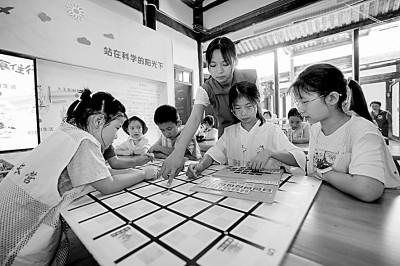
In a popular science education base in Antai Street, Gulou District, Fuzhou City, Fujian Province, science and technology volunteers accompanied the children to experience the technology model device. Xie Guiming photo/bright picture

College student volunteers from more than 10 institutions of higher learning, including Shandong University of Technology, Jinan University and Liaoning University, set up a public welfare class for primary school students in Jimo District, Qingdao City, Shandong Province. Xinhua news agency

Education, science and technology and talents are the basic and strategic supports for building a socialist modern country in an all-round way. It is the responsibility of the times for education to accelerate the modernization of education and build an educational power, so as to promote Chinese modernization. In this context, "what is education and where is education going" has become a major issue that needs in-depth thinking. Facing the future, where is the orientation and direction of education development, and what problems and shortcomings still exist? How should we make accurate efforts and grasp the key points in order to take the road of educational modernization? The reporter recently interviewed Yang Xiaowei, a professor at East China Normal University and former director of the Institute of Basic Education Reform and Development, to discuss related issues.

To realize modernization, how to understand the change of educational concept

Reporter: In 2035, China will basically realize socialist modernization. This is an important time node. The modernization of education is a process of catching up with the advanced education level in the world, and it is also a process of continuous development and advancing with the times with the development of the times and the deepening of practice. In this context, how can we better understand the overall goal of promoting educational modernization and do a good job in the strategic deployment and overall design of a strong educational country? From a strategic point of view, the proposal of educational modernization requires us to adjust the original concept.

Yang Xiaowei:The goal orientation of China’s educational modernization has undergone changes or upgrades with the times. The general thread is from "modernization-oriented" to "modernization with China characteristics" and then to "modernization with Chinese characteristics", and the promotion from "localization" to "characteristics" to "China style" has been realized. In the orientation of national strategy, from education serving modernization to the modernization of education itself at the same time, it has also experienced an order of magnitude improvement from "basic realization" to "overall realization" of educational modernization. According to "China Education Modernization 2035", "by 2035, we will realize the overall education modernization, step into the ranks of educational power, and promote China to become a country with great learning, human resources and talents", and clearly put forward that education modernization should lay a solid foundation for building a socialist modernization power. The status of education has also been upgraded from "priority development" to "overall, basic and leading status" and then to "power and foundation of a strong country".

The programmatic document "China Education Modernization 2035" is intended to "make strategic deployment and overall design for accelerating education modernization and building an education power with a higher historical position, a broader international vision and a deeper strategic vision". Among them, promoting educational modernization is the path, and building an educational power is the goal. Specifically, it is through the strategy of rejuvenating the country through science and education, the strategy of strengthening the country through talents and the strategy of innovation-driven development to build a strong country through education. Building an educational power is a process of dynamic improvement, which requires "pushing China’s education forward in a higher quality, more efficient, fairer and more sustainable direction".

In the overall design, the goal of building an educational power is "total-division-total" design, that is, building a "modern education system" and forming a "new pattern of governance" is the "total", and the development goals of all levels and types of education in the middle are "division"; The guiding ideology, basic ideas, overall goals and strategic tasks are the design of "virtual" and "real", the ideological concept is "retreat" and the goals and tasks are "pragmatic"; From the relationship between development goals, strategic tasks, implementation paths and safeguard measures, it embodies the gradual and interrelated strategic operation mode of "purpose-content-means-guarantee".

From the strategic point of view, in the overall strategic level, education, science and technology and talents should be corrected from the previous "fragmented thinking" to the "trinity" collaborative thinking, making it the basic and strategic support for building a socialist modern country in an all-round way; On the overall strategic level, under the guidance of the goal of "total-division-total", we should promote the high-quality development of education at all levels and realize our own modernization; At the operational strategy level, we should focus on some key and difficult issues, such as deepening evaluation reform, information technology empowerment, modernization of governance system and governance capacity, etc., deepen education reform from details and parts, and promote the connotative development of education.

To promote educational modernization, we need to focus on three key themes.

Reporter: Educational modernization is a high-level development state of education, a transcendence of traditional education, and an all-round transformation of educational development concept, development mode and system. What are the problems that need to be solved in the implementation of the blueprint for educational development described in the outline of the long-term goal in 2035?

Yang Xiaowei:It is the long-term goal of China’s educational modernization in 2035 to build a high-quality modern education system serving the lifelong learning of the whole people and form a new pattern of educational governance in which the whole society participates. But at the implementation level, we still face many problems that need to be solved urgently.

First of all, the integrated development of education, science and technology and talents is the most critical, but the coordination among the three parties is also the most difficult. The biggest problem in practice is how to truly integrate science, technology and education in terms of concept, goal, planning, management system and implementation mechanism, and how to find the accurate position of talent development in its integration. Generally speaking, adhering to the priority development of education is the foothold of the basic strategic support for building a socialist modern country in an all-round way; Insisting on self-reliance and self-improvement in science and technology is its starting point; Adhering to the talent-led drive is its traction point. These three orientations should be the breakthrough point to solve the problem of the integration of education, science and technology and talents.

Second, quality change, efficiency change and dynamic change promote the high-quality development of education, which is not difficult to understand logically, but it still faces bottlenecks in practice. Specifically, it is difficult to establish the concept of quality first and benefit first, to improve the total factor productivity through factor allocation and structural optimization, and to stimulate the vitality of schools and form endogenous motivation.

The difficulties related to quality reform are mainly how to get rid of the single one-sided quality view, which only focuses on entering higher schools, and establish the overall quality view of all-round development of morality, intelligence, physique, beauty and labor; The difficulty related to efficiency reform is mainly whether we can correctly maintain the relationship between fairness and efficiency, avoid the rigid operation of either/or, and form a complementary and perfect relationship; The difficulty related to the dynamic change is mainly how to correctly grasp the relationship between breaking the old kinetic energy and cultivating new kinetic energy, and further clarify how to break the old "involution" kinetic energy that only focused on scores and enrollment rate in the past, and cultivate new kinetic energy such as curriculum innovation, classroom innovation and school-running vitality.

Finally, all kinds of educational reforms at all levels need scientific evaluation most after entering the deep water area, but the reform of educational evaluation needs to be deepened. Whether the evaluation standard is reasonable, whether the evaluation can generate incentive force, whether the evaluation tool is scientific and feasible, whether the single result evaluation can be improved, whether the process evaluation can be optimized, and whether the comprehensive evaluation can be sound and so on all need to be overcome.

Reporter: Finding the connection point between the development of education and the process of national modernization is the key to accelerate the modernization of education and build an educational power with high quality. What are the key themes to focus on in the process of educational modernization in China?

Yang Xiaowei:One of the key themes is to integrate education, science and technology and talents to jointly support the construction of a strong education country. It can be roughly divided into three sub-themes: research on the relationship between the three, research on the integration mechanism and research on the path of strengthening the country. In the past, the independent exploration in the fields of education, science and technology and talents needs to be turned to cross-field, cross-industry and cross-regional collaborative exploration, which can not only focus on any one of the three, but also connect with or infiltrate the other two, and can form a higher level of overall planning beyond the three parties.

The second key theme is to promote the high-quality development of education in China with quality change, efficiency change and dynamic change. The high-quality development of education is a new mode of development. At present, the "transformation mode" of education is to shift from the extensional development of pursuing speed, scale and hardware upgrade to the connotative development of pursuing fair, high-quality and sustainable development. Its specific characteristics are strengthening factors, adjusting structure and optimizing ecology, and realizing the overall improvement of education quality and efficiency. The quality change is oriented and related to the direction of high-quality development of education; Efficiency reform is a process, and its key lies in expanding efficiency vision, upgrading efficiency level and pursuing efficiency priority. Dynamic change is regulatory, and the key is how to effectively mobilize the enthusiasm of the development subject.

The third key theme is to deepen the evaluation reform to promote the fair, high-quality and sustainable development of education. The deepening of educational evaluation reform is a systematic project, which involves the top-level design and concrete implementation of evaluation schemes at different levels, the commonness and particularity between different gradients in the east, west, urban and rural areas and various types of education, and the mutual transformation between strategic objectives and evaluation indicators, evaluation concepts and evaluation tools, evaluation process and evaluation results. It is necessary to have an overview of the overall situation and analyze it in detail. We can focus on the key indicators that reflect their own characteristics and needs in the evaluation of various regions, schools at all levels and different curriculum areas.

Learn to "discover modernity from tradition" and try to "discover the future from reality"

Reporter: Institutional innovation is regarded as the fundamental driving force of educational modernization. In the face of the urgent problems faced by the current educational development and the concerns of the people, what outstanding problems and weak links should we focus on to make breakthroughs and innovations to ensure the realization of the goal of educational modernization?

Yang Xiaowei:Let’s talk about outstanding problems and weak links first. Urbanization is the general trend of modernization, but we should also see that rural areas generally lag behind cities. The overall development of education needs to fill the "short board" of rural education in particular. In addition to simultaneously promoting the modernization of rural education by cooperating with the rural revitalization strategy, we must also promote the integration of urban and rural education in a more reasonable and effective way, with the city leading the countryside and the countryside promoting the city and the symbiotic development.

According to our on-the-spot investigation, secondary vocational education in China is generally faced with the embarrassing situation of being at a loss for further studies and employment. For secondary vocational schools, the integration of general education and vocational education weakens the employment orientation of vocational education to a certain extent, and strengthens the cultural foundation and the orientation of further studies. However, there are not many ideal universities for secondary vocational school graduates who want to choose further studies. Therefore, it is necessary to promote the innovation and diversification of the general-vocational diversion mode, and explore a variety of new modes based on the "3+N" mode. For example, secondary schools are not classified, but the different needs of different orientations of further studies and employment are met by "curriculum diversion".

Special education is also a weak link, and the problems such as insufficient investment, improper teacher-student ratio and shortage of regional special education resources hinder the healthy development of special education. It is necessary to further expand the resources of special education and promote its inclusive development.

New breakthroughs are also needed in mechanism, mode and technology. In terms of mechanism, the operation mechanism of urban-rural integration has formed some good achievements and experiences in various places. Among them, the operation mechanism of school management in school districts and groups, the promotion mechanism of high-quality balance in the field of basic education, the promotion mechanism of comprehensive reform, the adjustment mechanism of kindergarten degree supply, the expansion mechanism of high-quality educational resources, the management mechanism of "county management and school employment" for teachers in compulsory education schools, the diversification of high school running models and the development of high-quality characteristics are all worth exploring.

In terms of new models, in addition to a large number of new models, such as school district-based group running, entrusted management, "one school with multiple districts/schools" and "new high-quality schools", it is worth continuing to tap the potential and expand the capacity. In promoting the combination of special education with general education, vocational education, medical rehabilitation and information technology, creating demonstration zones and schools for integrated education, and promoting the construction of multi-level special education resource centers from the state to the local level, it is also necessary to intensify exploration.

In terms of new technologies, big data, the Internet of Things and artificial intelligence technologies, the "future school" model integrating new concepts and new technologies, and the application of artificial intelligence products in education all need to be demonstrated by organizing some experimental, simulated and immersive explorations.

Reporter: To promote educational modernization, we must take root in China, integrate China and foreign countries, base ourselves on the times and face the future, draw nutrition from China’s excellent educational traditions and actively absorb and learn from international advanced experience. What problems should we pay attention to avoid in this regard?

Yang Xiaowei:In the process of building Chinese-style modernization, China has a "late-comer advantage", which not only provides rich resources and valuable reference for China’s modernization, including educational modernization. Based on this, on the one hand, we should avoid "looking only at foreign things" and "not eating foreign things", on the other hand, we should respect the national conditions, be good at learning from them, learn to "discover modernity from tradition", and also let go of our imagination, be brave in foresight and try to "discover the future from reality". In short, we should grasp the right degree between adhering to tradition and absorbing foreign countries, basing ourselves on the present and creating the future.

(Reporter Yan Xiaoyan)